

I knew if I was visiting southern Spain I’d have to find a way to get to Granada to see the Alhambra. The Alhambra is a 13th century fortress with palaces and gardens that was once home to the Moorish monarchs. While seeing the Alhambra was the main purpose of our visit to Granada, we thankfully had time to explore some of the nearby neighborhoods and other attractions in the city, whose name means “pomegranate” in English.
If you haven’t already, check out my last two blog posts where I shared details about my trip and what we did during the first leg in Sevilla:
Two Weeks in Spain: Itinerary and Details


Where We Stayed
We stayed at Hotel Puerta de las Granadas, a boutique hotel located very close to the Alhambra. While I was in charge of planning the activities, my dad was in charge of picking the hotels—and he nailed the location once again. This was within easy walking distance of all the places we wanted to visit and was almost as close as you could stay to the Alhambra complex. This hotel was much more modern than the place we stayed in Sevilla, so it had slightly less charm, but was still a really nice spot.
We took a taxi from the train station to our hotel because we wanted to save as much energy as possible for touring the Alhambra. However, when we left the city we ended up walking back to the train station, which was only 25 minutes and easily doable with fresh legs.


Albayzín Neighborhood
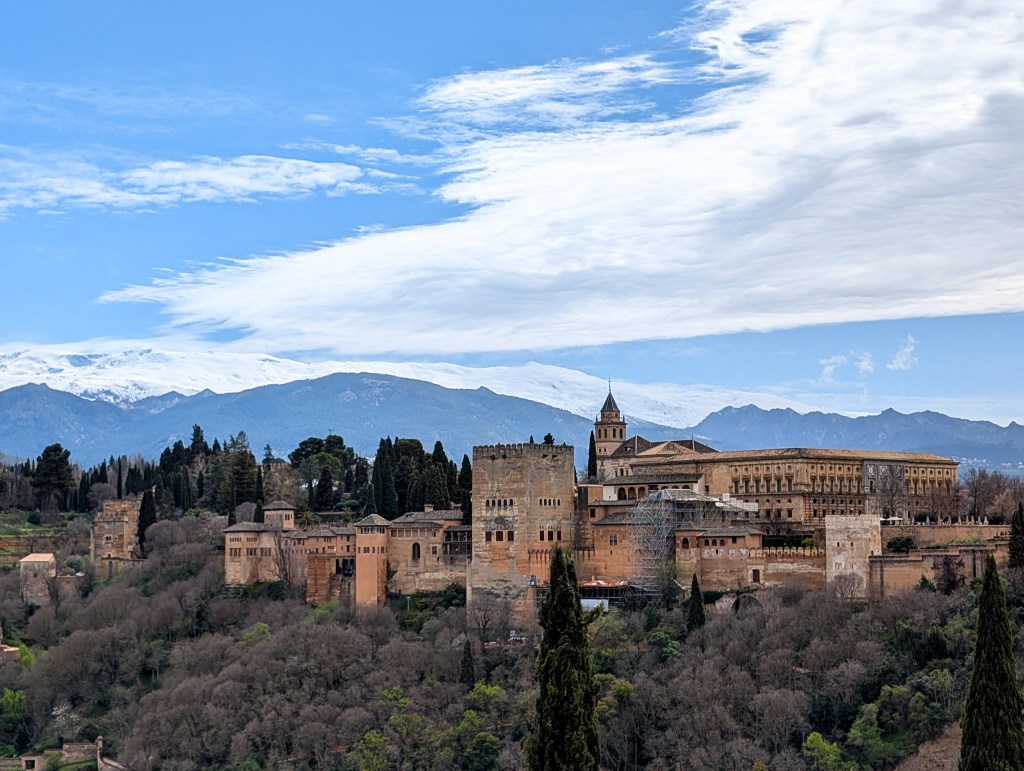
After checking into our hotel, our first stop in Granada was exploring the Albayzín neighborhood, which is a world heritage site. It’s characterized by steep hills, narrow walkways, white houses, and viewpoints of the Alhambra. It was very residential, with few restaurants and shops, so we just quietly wandered and enjoyed the architecture. I read online that the best viewpoint of the Alhambra is the Mirador de San Nicolas (pictured above). Sure enough, it was an incredible view of the fortress—and as such packed with tourists. It’s shocking I was able to get any photos without people in them. This viewpoint isn’t a place I would stay long due to the crowds, but we did end up finding a nice spot a little lower down where we could watch the sunset and see the Alhambra illuminate the night sky.


Alhambra
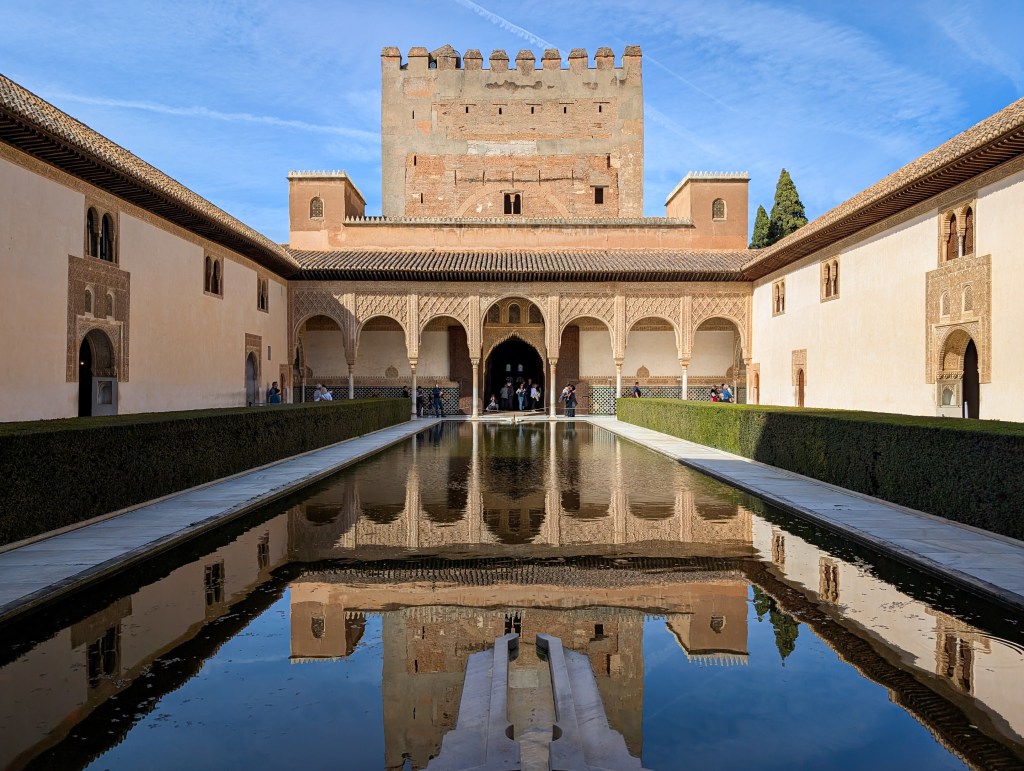
I did a ton of research on the Alhambra, and most articles I read recommended paying for a guided tour. There are very few signs and things to read throughout the complex, so without a guide you would learn very little about the grounds’ fascinating history (which is the best part!). I ended up buying tickets from this tour company on Viator. Our group was small and they used this technology where the tour guide spoke into a microphone and everyone else had headphones, so you could still hear perfectly even if you were at the back of the group (genius! I had never seen that method before but all the tour groups were using it). Our tour lasted three hours. I really can’t recommend a tour enough because between the Generalife (the gardens), the Nasrid Palaces, the Alcazaba, and the Charles V Palace, there is a LOT to see. And there are various security points. It would have been so overwhelming to try to see it all without an experienced guide to show us the way.


Make sure when you book your tour that it includes entry to the Nasrid Palaces and Generalife, as some tours do not include your ticket into the complex. It was confusing to me which parts of the Alhambra you had to pay to see and which were open to the public, and as such which tours contained entry to which parts. Make sure you read very carefully. You also have to enter your passport information when you book and show your passport several times when you go through security checkpoints. Attention to detail is everything here! I was very nervous about somehow screwing something up and missing our opportunity to see the Alhambra, since it sells out months in advance. I considered booking the tour and then buying additional general admission tickets through the Alhambra’s website—as a backup—but by the time I made that decision the general admission tickets were already sold out. I booked our tour a month and a half in advance, but even that was cutting it close. If you miss the opportunity to purchase entry tickets from the website directly, you can often still get entry by purchasing a tour.
I’m so glad we were able to go and that the tour worked out. We learned so much, and the grounds were truly breathtaking. The Alhambra was hands-down my favorite part of the trip.


Capilla Real
There are lots of religious sites to see in Granada, including multiple monasteries, the cathedral, and, next door to the cathedral, the Capilla Real. The Royal Chapel is where the Catholic Monarchs Ferdinand and Isabella are buried. You aren’t allowed to take photos inside, understandably, but it was really incredible to be there. There was a huge, intricate marble mausoleum and then you could walk down a couple of steps into the crypt to view the wooden coffins. It was hard to wrap our heads around how old the coffins were and how monumental these figures were to Spanish history. A must-see, in my opinion!


Real Monasterio de San Jerónimo
The only other site we had time to see during our short stay in Granada was the Real Monasterio de San Jerónimo, where we were able to purchase entry at the door. At this point we were kind of sick of audio guides, so we chose to just quietly wander and take in this peaceful site. It also had an incredibly intricate church where nearly every inch of it was part of a painting (see above). We didn’t stay that long but it was the perfect way to kill the last hour and a half we had in the city.


In some ways Granada felt similar to Sevilla, but it was unique in that it was very hilly and nestled in the Sierra Nevada mountains, with, of course, the Alhambra in the skyline. I’m so grateful we made the time to see it during our trip!
Miles of smiles,
Grace


Leave a Reply